
Get Blog Updates

Your email:

NEW! Plagiarism Detection Resources

Learn how to make plagiarism prevention an easy task.

SEE RESOURCES

Awards

Blog | Plagiarism Prevention

ABOUT: The iThenticate Blog is an award-winning web site that discusses plagiarism and other scholarly misconduct issues. Topics covered help raise awareness of the growing plagiarism problem, and promote integrity and ethical writing practices. To contact us, send us an email.

Top Plagiarism News:

Current Articles | RSS Feed RSS Feed

What Is Self Plagiarism and How to Avoid It


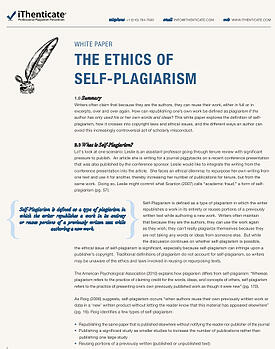
self plagiarism white paperWriters often maintain that because they are the authors, they can reuse their work as they please; it couldn't be defined as "plagiarism" since they are not taking any words or ideas from someone else. However, while the debate on whether self-plagiarism is possible continues, the ethics of self-plagiarism is significant, especially because self-plagiarism can infringe upon a publisher’s copyright.

Traditional definitions of plagiarism do not account for self-plagiarism, so writers may be unaware of the ethics and laws involved in reusing or repurposing texts.

Addressing this growing area of concern (for authors, researchers, publishers and organizations alike), iThenticate has examined the definitions of self-plagiarism and offers advice on how self-plagiarism can be avoided in its new white paper, "The Ethics of Self-Plagiarism."

Download the free self plagiarism white paper »

Avoiding Self Plagiarism

Organizations and individual authors and researchers can take preventative measures in their writing practices and editing processes, including the use of plagiarism checker technology that helps detect potential self-plagiarism before publication. The white papers gives readers insight on best practices from the following resources:

Related

Self-plagiarism Webcast (Video)

What researchers and journals can do to prevent self-plagiarism (Video)

Comments

I read your white paper on self-plagiarism with interest. While your comments and guidelines are clearly founded in dictionary definitions and laws, general scholarly practice is not compatible with them. The following two examples illustrate my point: 
 
- A PhD student publishes several papers prior to submitting her thesis. She creates her thesis by reusing figures and text from these papers. This thesis then appears on a university web site for free downloading. Typically in these cases text and figures are reused without asking permission from the publisher of the papers and without citing papers explicitly where text and figures are reused. 
 
- A laboratory director is asked to summarize research work in his lab. He writes a paper that summarizes ten years of research and cites all relevant journal publications. A fair amount of text is cut and pasted from previous papers where he is an author. While it is stated explicitly that the article is a summary of previous research and previous articles are cited throughout the paper, following standard practice, the laboratory director does not "pompously" quote himself using quotes " " every time text is reused. The summary paper appears in an on-line open source journal where no copyright transfer is required. 
 
In my view these two examples do not illustrate unethical behaviour. 
Yet following your white paper, they would be.
Posted @ Thursday, September 08, 2011 3:17 PM by Ian Smith
Very good and interesting paper.
Posted @ Friday, September 09, 2011 11:02 AM by Dr Goda Sporn


I would like to know if a person is hired to create a project for a school district -- and that person is paid for their work for the district reports and data -- can that person then take the survey instruments, goal, etc and use the exact same framework, questions, goal, for another district for the same type of project? Does the first school district become the "owner" of the project or is the employee the owner of the project -----
Posted @ Thursday, October 06, 2011 3:03 AM by maryellen
"...the ethics of self-plagiarism is significant, especially because self-plagiarism can infringe upon a publisher’s copyright." 
 
Let's be clear here. The issue is ONLY about copyright infringement. It has nothing to do with ethics per se, but only with rules made up by existing publishers to protect an unfair and unsustainable business model. The future belongs to open access journals, where authors hold the copyright, it seems.
Posted @ Thursday, December 29, 2011 4:58 AM by Jack Werter
Let us imagine an aerosol chemical composition study laboratory. There are 10 students working with a professor. The experimental procedure to analyze the samples remains same but every student use different area samples (different parts of the world). I am interested to know, how they can write experimental procedures in 10 different ways. Is it comes under self plagiarism?
Posted @ Thursday, January 19, 2012 8:19 PM by Prashant
Thanks to all for your comments! 
 
@Ian, I echo @Jack that it all boils down to copyright protection. If a journal publishes a manuscript, the concept of today is that it's theirs and other usage of that content, in theory, has a monetary loss and puts their reputation at risk. 
 
@Prashant, At what point is self-plagiarism an issue in this situation? I am interested to hear what others have to say about how self-plagiarism could enter collaborative research.  
 
Retraction Watch Blog posted an article today about The American Chemical Society (ACS) Nano journal retracting a study due to self-plagiarism: http://retractionwatch.wordpress.com/2012/02/01/no-small-matter-acs-nano-journal-growing-alarmed-by-self-plagiarism/
Posted @ Wednesday, February 01, 2012 12:06 PM by Jessica G
Plagiarism and copyright are two distinctly different, but related, issues. I could get copyright permission to reproduce something, but if it's still plagiarism if I don't cite it appropriately. Copyright has to do with money and can be transferred, plagiarism has to do with credit for the creative work, and there's no way to transfer "plagiarism rights." 
 
Personally, I despise the term self-plagiarism, since plagiarism means passing the ideas and creative output of a *different* person as your own. The ethical violation here should more rightly be called something like "double-dipping." 
 
In Prashant's scenario, the PI publishes a paper with each member of the lab on his or her aerosol, and each paper has an identical "methods" section because their methods are the same. If "self-plagiarism" follows the same rules for plagiarism, they're in trouble. If what we really want to avoid is taking credit for the same thing twice, then it's clear that there is no ethical violation here.
Posted @ Friday, March 23, 2012 9:40 AM by Allison
I completely agree with Allison. I think that someone may be trying too hard to sell software here. The formulation "self plagiarism" is a contradiction. It occurs in Academic practise ALL the time.  
There is even a regular violation of author's rights (this is different from publisher's rights). Lawyers will tell you that if someone re-publishes something that originally had multiple authors (say in a paper) as a single author (by one of the multiple authors), then the whole text needs to go in quotes. Imagine quoting oneself! The worst fallout of this is that most PhD theses violate author's rights when multiple-author papers have already been published from the results. There is clearly a number of gaps between academic practises and strict interpretations of the law.
Posted @ Friday, March 23, 2012 12:06 PM by Ian Smith
Self Plagiarism really!!!! If your the inventor of your own works the word smith of your own words. Why do you have to reinvent them? If you can actually reference yourself. The biggest problem occurs when one uses another person's work with out crediting them? The feel that self plagiarism is over rated. Can one person tell me with certainty that the combinations with which words could be arranged is infinite? The world contains over 5bn people about a billion of which can write. Words, phrases and all that are redundant. Redundancy is every where in nature. It is so annoying that even software will catch phrases such as Materials and Methods as plagiarism. I have a strong feeling that this has nothing to do with the question of weather self plagiarism is ethical or not. I think money is involved.
Posted @ Tuesday, April 03, 2012 7:38 AM by Cano
I will think about avoiding self plagiarism the day college textbooks stop re-releasing the SAME TEXT as new material every year for $150. If that isn't "self-plagiarism", I don't know what is.
Posted @ Thursday, April 12, 2012 4:36 PM by Neetish
Another good reason to selfpublish: they're my words and I'll repeat them whenever I damn well fancy. In fact, within Corvus I've even repeated whole sentences: go on, play the Google Game and find them!
Posted @ Friday, June 29, 2012 11:09 AM by Lee
The following article from Concurrency and Computation Practice & Experience, “Efficient and scalable complete exchange (all-to-all personalized) communication operation on 2D all-port torus networks”, by Baransel, C.; İmre, K. M; and Artuner, H, published online on November 3rd 2011 in Wiley Online Library (wileyonlinelibrary.com), has been retracted by agreement between the authors, the journal Editor-in-Chief, Geoffrey C. Fox, and John Wiley and Sons, Ltd. The retraction has been agreed due to overlap with another longer paper by the same authors entitled " Efficient and Scalable Routing Algorithms for Collective Communication Operations on 2D All-Port Torus Networks" published in International Journal of Parallel Programming (Springer). It is thus considered a shorter version or “subset” of the International Journal of Parallel Programming paper and so a redundant publication. 


http://onlinelibrary.wiley.com/doi/10.1002/cpe.1886/full
Posted @ Monday, October 08, 2012 6:51 AM by Mikhael Dobrowsky
Looking for "self-plagiarism" could be very damaging to scientific publication and discourse, even though it could serve the commercial interests of iThenticate. Most scientists will publish multiple papers on the same topic, extending their research little by little. Hence, most papers from an author will discuss similar topics. One may then expect that introductory and methods and materials sections to have a high degree of similarity to other papers the author has published. Even if the author writes these sections from scratch and not using the copy function of their favorite word processor, one would expect a high degree of similarity since the author is likely to discuss a topic similarly from paper to paper. It is well-known that people tend to say the same things the same way. Does this present a commercial problem with publishers? It hasn't yet, and there is not reason to expect this to be an issue suddenly now. Jessica G is inferring that suddenly this has become a problem, but presents no evidence to support this assertion. 
Publishing similar works in different venues is useful in scientific communication. For instance, publishing a theory paper on a topic in journal A (theoretical readers), an application of the theory in journal B (applications readers), and a discussion of methods in journal C (methodological readers), all with different audiences, is very useful. And yet all 3 of those papers would have similar content in much of the papers. But there is no plagiarism, as all three papers are the author's original work. This multiple positioning of the original scientific work does not deleteriously affect the value of any of the publications, but instead creates a support grouping of publications: The applications readers will want assurance that the theory is well-constructed, and the theory specialists may want assurances that the methodological issues have been appropriately vetted. To accomplish this, the same results may be shown in all 3 papers, but with different emphasis of analysis and interpretation. Indeed, often it is necessary to already have similar publications on the topic discussing other aspects in order to get published.
Posted @ Thursday, December 13, 2012 5:59 PM by Russell Reeve
Thanks for your comment, Russell. You raise some good points, and I believe you will find many of them addressed in our recent webcast, during which you will hear publisher and journalist perspectives directly: http://www.ithenticate.com/self-plagiarism-webcast. Yesterday I published an interview on the iThenticate Blog that features a member of COPE and editor of JAANP, and she touches on the topic. But I'll chime in a bit here myself.  
 
In regards to the explosion of plagiarism and self-plagiarism or "duplication" as many publishers refer to it: I would say the internet and the availability of content has made it easy to uncover problems in writing. With the rise of technology comes new issues. Teachers have never approved of students taking previously submitted papers and using it on a new assignment. Whether or not it has always been called self-plagiarism, I'm not sure. But I do know publishers have been using the term for years. COPE, publicationethics.org has many cases posted on their site from early 2000's. When it comes to professional publishing, publishers do not want researchers re-using their work because typically it is copyrighted under one publisher. If it gets published under another publisher without attributing the original source, that is copyright infringement. I agree that this is a controversial topic, but it is not going away any time soon. There are many new and unique situations arising between researchers and publishers, and it appears they are working to figure out best possible solutions as they go. Having said that, I think it's wise for researchers and authors to read a publisher's or journal's policies prior to submitting their work to a publication in order to understand what will happen to their research. I have noticed several journals recently stating their definitions and policies around self-plagiarism on their author information pages. It's a term that more publishers are starting to reference more openly and I think that's great because it is important for people to know about in order to avoid it.
Posted @ Friday, December 14, 2012 12:07 PM by Jessica Gopalakrishnan
I appreciate your response. However, I don't think it addresses the issue, which is the incremental approach that science works under. If you look at the number of publications coming from the Framingham Heart Study (Google Scholar indicates something along the lines of 49,000 publications), there is going to be a lot of redundant information there, even though each publication adds something new. One can describe this study in only so many ways; most of them are going to score very high on any sensible similarity index. Some papers are methodological, some are applied, some are hypothesis generating, etc. Are we to wait until we have all of the work on this study completed before publishing? And if we do publish, are we then precluded from publishing the remaining 48,999 publications because the follow on publications contain redundant information?  
 
Most journals have length limits, which limits the amount of information that can go into any given paper, and hence the need to reproduce some information from one paper to the next. None of this can seriously be considered "self-plagiarism." As an alternative, one could limit the problem of "self-plagiarism" by demanding that prior information be referenced, and not repeated in the submitted paper. This makes it difficult on the reader, however, who must then collect multiple papers and read them all before understanding the current paper. If you want your journal to be well-read, having unreadable papers does not sound like an appealing solution. 
 
I would like to hear your and others thoughts on these issues.
Posted @ Friday, December 14, 2012 12:37 PM by Russell Reeve
If I am writing a book chapter collecting material from my own previous published papers, then do I get into self plagiarism issues. In that case, what are the precaution I need to take 
(a) reword the sentences and cite the references 
(b) obtain copyright information from the publishers to publish figures and tables as it is and cite the references. 
 
Is that all I need to do or do I need to take care of other things. 
 
Any help would be appreciated. 
 
Raju
Posted @ Saturday, January 26, 2013 5:21 PM by Raju
Hi Raju. Thanks for your comment. If you cite your own previously published works, it shouldn't be necessary to reword the sentences. In regards to the figures/tables, as I understand, if you cite the source, it should be fine to use in most cases. It is always a good rule to check publishers' policies as they do differ.
Posted @ Monday, January 28, 2013 12:24 PM by Jessica Gopalakrishnan
I am writing my Ph.D. thesis, which I will submit soon to a good university which uses iThenticate software to check plagiarism. As per the university norms a student has to publish some minimum number of research papers for the award of the degree. From my work I have publishes about 90% of the content in various international journals. As the papers are based on the work which I have to present in thesis also. If I will use the text of paper in thesis then is it plagiarism? as the results we can not change and the discussion of results will be also same. In this case, I can not cite papers explicitly where text and figures are reused as the papers are based on the thesis work only. If rewriting, I can change some sentences only not results of their discussion/reason. Can anyone help me in this regard that what should I do that it will not considered as self-plagiarism.
Posted @ Monday, February 11, 2013 3:47 AM by Rajendra Awasthi
Pls help me too as I am also working on my Ph.D thesis
Posted @ Saturday, February 16, 2013 2:33 AM by
I agree strongly with many of the above comments. The issue of self-plagiarism is complete nonsense and is created by the convergence of software capability (we can do it so we will) with the proliferation of academic publishing channels (we shouldn't, but we have to) and the related pressure from institutions to publish (you can therefore you must). Combine this with the profit motive of academic publishers (you work, we earn) and you have the ridiculous situation where academics are being criminalised for making the maximum use of their own work. 
I applaud iThenticate for providing this blog but they are simply adding to the already farcical publishing situation in academia.
Posted @ Tuesday, February 26, 2013 7:06 AM by Peter Gray
very nice post and great idea! thanks for share :)
Posted @ Saturday, May 04, 2013 12:33 PM by sogellizer
I am writing my PhD student thesis in now the so called "Journal Papers Format" where my work has to be published in various international journals. Thereafter, will be wrong if I lift the papers as published to form my thesis?
Posted @ Thursday, May 16, 2013 2:58 AM by Leonard
Post Comment
Name
 *
Email
 *
Website (optional)
Comment
 *

Allowed tags: <a> link, <b> bold, <i> italics